 |
Cheat Engine
The Official Site of Cheat Engine
|
| View previous topic :: View next topic |
| Author |
Message |
zezikaaikwe
How do I cheat?
![]() Reputation: 0 Reputation: 0
Joined: 31 Mar 2012
Posts: 4
|
 Posted: Sat Mar 31, 2012 7:43 pm Post subject: Output to File...I'm stuck! Posted: Sat Mar 31, 2012 7:43 pm Post subject: Output to File...I'm stuck! |
 |
|
I've been trying to figure this out for a long, long time on my own. Rather than spin around in circles forever, I thought I'd reach out to the experts. As a disclaimer, I'm a bit of a noob, so bear with me...
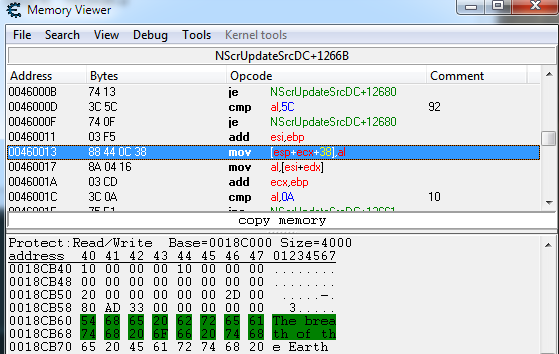
What I want to do is simply log text displayed in my program to a file every time it changes. That's all. I'm at the point where I've located the address where the text is written to, and I've found the address that writes to it:
[not allowed to use URLs, so I've attached the images]
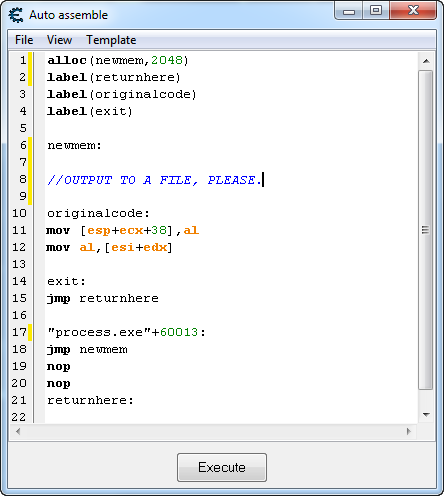
Okay, so now I suppose that I need to get that value out to a file via a code injection as per the tutorial. I'm trying desperately to do this, but I'm just not sure how to:
- write the assembly to output the value of the address to a file, or
- call a Lua script / C++ dll to do it
Is there a simple way to do this? Every similar link I've come across has to do with a simple "logfile:write", but I just don't know how to even begin to call that or reference the values I've found. Similarly, I don't even really understand how to loop in Lua into the code.
Any help would be much appreciated; my mind is spent. Thanks all.
| Description: |
|
| Filesize: |
21.83 KB |
| Viewed: |
3886 Time(s) |
|
| Description: |
|
| Filesize: |
26.32 KB |
| Viewed: |
3886 Time(s) |
|
|
|
| Back to top |
|
 |
booingthetroll
Expert Cheater
![]() Reputation: 0 Reputation: 0
Joined: 30 Aug 2011
Posts: 114
Location: ::1
|
| Posted: Sun Apr 01, 2012 9:15 pm Post subject: |
|
|
If you're a beginner, then in my opinion, your best bet will be Lua.
Example code:
local file = io.open("C:\\Users\\Taco\\HelloWorldProgram.lua", "w")
file:write("print('Hello World')")
Also, look at readBytes.
I'm assuming something like this would work.
Address = "Put address here"
Previous = readBytes(Address, length of string -- if the length is always different, then put the maximum length it gets to.)
while true do
Current = readBytes(Address, length of string -- what I said earlier)
if Previous ~= Current then
local file = io.open("C:\\Users\\Taco\\Log.lua", "a")
file:write(Current)
end
Previous = Current
T = os.time()
repeat until T == os.time() - 1
end
I'm sorry if the code is buggy, inefficient or not working -- even if it doesn't work, it shows what I believe is the most easy way to do what you are trying to do.
|
|
| Back to top |
|
|
Dark Byte
Site Admin
 Reputation: 473 Reputation: 473
Joined: 09 May 2003
Posts: 25908
Location: The netherlands
|
|
| Back to top |
|
|
booingthetroll
Expert Cheater
![]() Reputation: 0 Reputation: 0
Joined: 30 Aug 2011
Posts: 114
Location: ::1
|
| Posted: Mon Apr 02, 2012 6:32 am Post subject: |
|
|
| Even though it's unneeded, I just noticed that I put what would delay the loop out of the correct scope, that being the loop although now it does not matter.
|
|
| Back to top |
|
|
|
|
You cannot post new topics in this forum
You cannot reply to topics in this forum
You cannot edit your posts in this forum
You cannot delete your posts in this forum
You cannot vote in polls in this forum
You cannot attach files in this forum
You can download files in this forum
|
|
 FAQ
FAQ Search
 Memberlist
 Usergroups
 Register
 Profile
 Log in to check your private messages
 Log in


